NBA
Is the Steelers offense actually fixable
Early in the fourth quarter at Gillette Stadium, Christian Barmore came free, hit Aaron Rodgers and knocked the ball loose. New England picked it up and ran it back. Game over. Except that wasn’t really the problem. The problem was that nothing about the play felt surprising. Pittsburgh had spent most of the afternoon making ... Is the Steelers offense actually fixable
Early in the fourth quarter at Gillette Stadium, Christian Barmore came free, hit Aaron Rodgers and knocked the ball loose.
New England picked it up and ran it back.
Game over.
Except that wasn’t really the problem.
The problem was that nothing about the play felt surprising.
Pittsburgh had spent most of the afternoon making life increasingly easy for New England’s defence. Run into traffic. Fall behind the chains. Ask Rodgers to throw against a defence that knew the throw was coming.
Repeat.
The final numbers were ugly enough: three points, 235 yards, 3.5 yards per play. Rodgers went 23-of-39 for 187 yards, threw an interception and took four sacks (ESPN; AP via CBS Sports).
But the scoreboard isn’t the bit that worries me.
It’s how Pittsburgh got there.
And this isn’t just one bad Sunday.
The Steelers are 1-1, not 0-2. They beat Atlanta 20-13 in Week 1.
The offence didn’t look much healthier then.
Per AP, via CBS Sports, Pittsburgh have managed one offensive touchdown across 25 possessions this season.
So yes, the obvious question is whether the offence can be fixed.
The better question is: what exactly is broken?
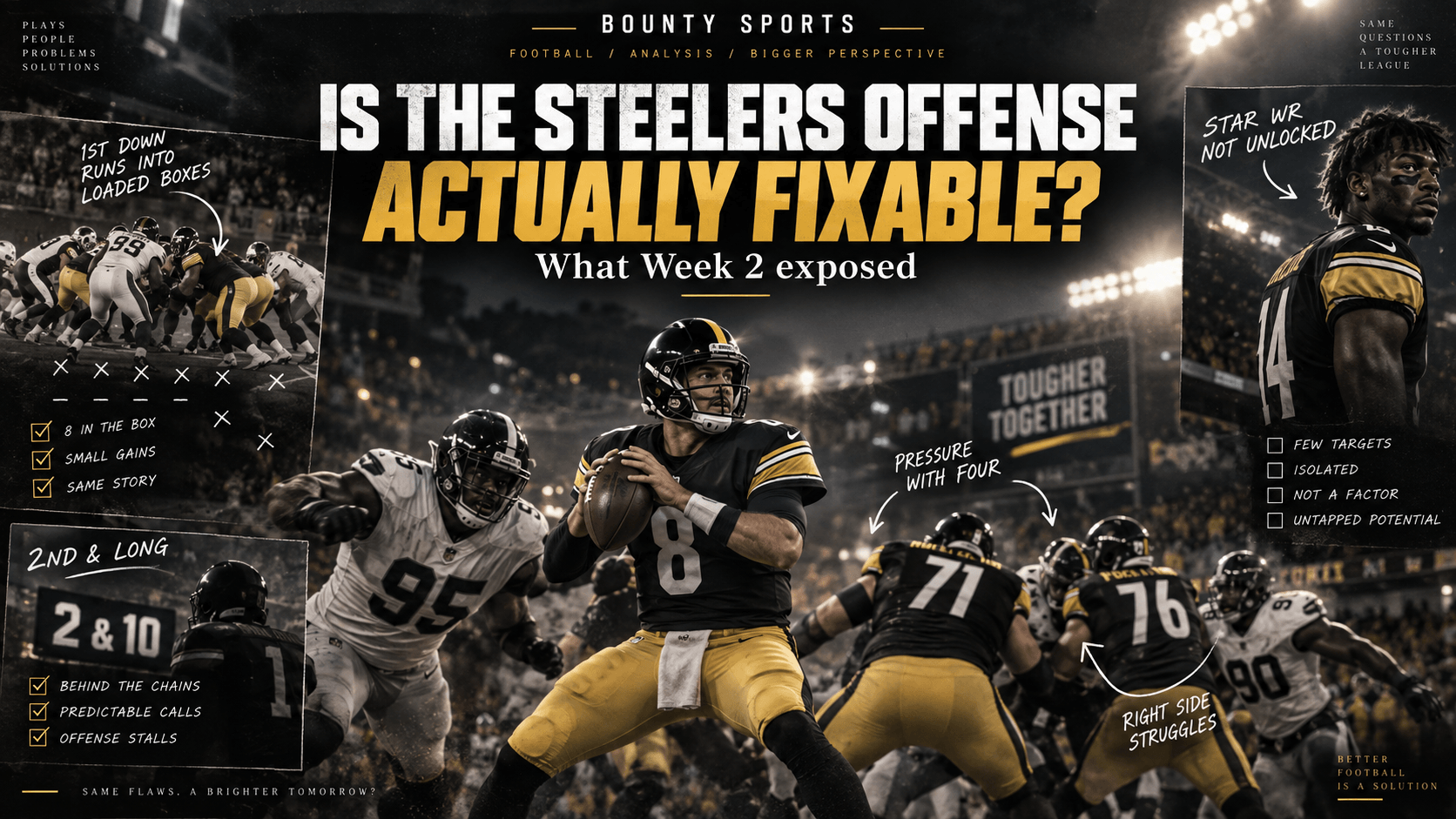
Start with first down
Watch Pittsburgh on first down.
This is where the whole thing begins.
They want to establish the run. Fine.
The problem is that defences know they want to establish the run.
So they load the box.
Now Warren or Rico Dowdle is being asked to run into one more defender than Pittsburgh can block.
Two yards.
Maybe three.
Second-and-eight.
And now the defence has won the down that came before the snap.
Because second-and-eight changes everything.
The run becomes less threatening. The pass becomes more predictable. The defensive line can attack rather than read.
Against New England, that was exactly what happened.
The Patriots pressured Rodgers on 38.6% of his dropbacks and blitzed him 21 times. More worrying for Pittsburgh, they still produced a 34.6% pressure rate when they didn’t blitz (Patriots.com).
That’s the number that matters.
If four defenders can bother the quarterback, seven get to stay in coverage.
Seven in coverage means Christian Gonzalez can follow DK Metcalf without New England compromising everything else.
And suddenly Rodgers is being hurried while throwing into a crowded picture.
That isn’t one broken block.
That’s an offence helping the defence.
The run game isn’t quite what the box score says
Pittsburgh averaged 4.0 yards per carry.
Read that quickly and it looks fine.
Watch how they got there and it looks different.
Jaylen Warren and Rico Dowdle combined for 65 yards on 18 carries. Neither had a run longer than ten yards.
Pittsburgh’s longest run — 14 yards — came from Travis Homer, who had two carries after Dowdle’s toe injury (Patriots.com; ESPN).
So the runs weren’t disastrous.
They were just harmless.
Four yards on first-and-ten can keep an offence moving.
Four yards on second-and-eight keeps the defence comfortable.
Pittsburgh kept putting itself in the second situation.
That’s why I would give Rodgers more control at the line.
If he sees a loaded box, let him get out of the run.
This is Aaron Rodgers. If there is one thing he should still be trusted to do, it’s count defenders before the snap.
It doesn’t fix everything.
It does stop the Steelers repeatedly choosing the defence’s preferred answer for them.
THE BATTLE: Pittsburgh’s right side
The easy diagnosis after four sacks is “the offensive line is bad.”
I’m not convinced it’s that simple.
There were concerns about the right side before the season. Sports Illustrated flagged Dylan Cook’s preseason struggles and Spencer Anderson’s inconsistency in August (Sports Illustrated).
Then Week 2 produced something awkward.
PFF’s grades, via Steelers Depot, actually liked most of the line.
Troy Fautanu: 74.5.
Dylan Cook: 73.2.
Mason McCormick: 69.0.
Zach Frazier: 65.3.
Spencer Anderson: 60.3.
That doesn’t look like five men getting destroyed.
And that’s why the tape and the grades are arguing with each other.
My read is that the line was part of the problem without being the whole problem.
Keep asking an offensive line to protect on obvious passing downs and eventually somebody loses.
Cook did. Steelers Depot highlighted one rep where he completely missed Robert Spillane and Rodgers had pressure in his face immediately.
Bad rep.
Real problem.
Still one rep.
The more important question is how often Pittsburgh creates that situation for him.
Watch this against Cincinnati: does Pittsburgh leave Cook isolated on obvious passing downs?
Give him help with a back or tight end and Rodgers may get another half-second.
But every helper staying in protection is also one fewer receiver in the pattern.
That’s the trade.
And Cincinnati will know it.
DK Metcalf is not the whole problem either
Four catches.
27 yards.
Two drops.
Nine targets.
Not good.
The pile-on is easy.
I’m more interested in what New England did because Metcalf was on the field.
Christian Gonzalez followed him.
According to Patriots.com, Metcalf caught only two passes for eight yards on seven targets when Gonzalez was the nearest defender.
Fine. Gonzalez won.
But when a defence dedicates its best corner to one receiver, somebody else is supposed to benefit.
Pittsburgh barely did.
Pat Freiermuth caught four passes for 32 yards.
Roman Wilson caught five for 28.
Nine receptions.
Sixty yards.
Nothing explosive.
Germie Bernard produced a 19-yarder. Warren had a 26-yard catch.
That’s about it.
So New England made a decision: put Gonzalez on Metcalf and trust everyone else to survive.
They were right.
That’s the bigger issue.
Metcalf has led Pittsburgh in targets in both games. The offence clearly wants to use him.
But simply lining him up outside and asking him to beat the other team’s best corner isn’t much of a plan.
Move him.
Stack him.
Put him in motion.
Force the defence to communicate before the snap.
Make Gonzalez work through traffic rather than letting him stand opposite Metcalf all afternoon.
Statistics tell us Metcalf caught four balls.
The football question is what Pittsburgh made New England change because he was there.
Right now?
Not enough.
So, is it fixable?
Some of it.
Fixable by Sunday
The sequencing.
Stop voluntarily running into overloaded boxes.
Throw earlier in downs.
Let Rodgers change more plays.
Help the right side when the situation demands it.
Get the ball out faster.
Those are coaching decisions.
No trade required.
No miracle required.
Fixable over the next month
The roles.
Can Max Iheanachor develop quickly enough to change the tackle picture?
Does Anderson hold up at guard?
Can Pittsburgh find better ways of getting Metcalf into space?
Can the secondary receivers punish teams for loading coverage towards him?
Those take reps.
Not really fixable
Rodgers isn’t suddenly becoming a quarterback who escapes pressure with his legs.
If Pittsburgh cannot block four-man pressure, there is no magical scheme that makes that disappear.
And this is a new offensive structure.
Brian Angelichio is a first-year coordinator. Mike McCarthy is in his first season as head coach. Rodgers is new to the offence.
Some things need time.
Pittsburgh isn’t a particularly patient place when the offence scores three points.
The verdict
So yes.
The Steelers offence is fixable.
At the margins.
Better first-down decisions could save a few drives.
Better protection sequencing could buy Rodgers a little more time.
Better use of Metcalf could force defences to make harder choices.
Those things matter.
They could be the difference between three points and 13.
Maybe 17.
What I haven’t seen yet is evidence that they turn this into a genuinely good offence.
That is a much bigger job.
Now Cincinnati
Cincinnati arrive at Acrisure at 2-0.
Pittsburgh are home underdogs.
FanDuel had Cincinnati -3.5 with a total of 42.5 on the morning of 22 September. ESPN’s DraftKings prices showed the same spread and total.
That feels understandable.
The market isn’t questioning Pittsburgh’s defence.
It’s reacting to an offence that has one touchdown across 25 possessions.
The total tells the same story.
And I don’t see much point arguing with it.
Everything we’ve just discussed is already sitting inside a number in the low 40s.
No obvious edge.
More importantly, this is a football question before it’s a betting one.
Watch first down.
Watch the right side of Pittsburgh’s line.
Watch whether Metcalf starts moving around before the snap.
If those things change, the offence might start looking different before the box score does.
FROM THE TOUCHLINE
The story: Pittsburgh are 1-1, but the offence looks much worse than the record.
The tactical question: Can the Steelers stop running into loaded boxes on first down?
The battle: Pittsburgh’s right side against Cincinnati’s four-man rush.
Player to watch: DK Metcalf — particularly where Pittsburgh lines him up.
Crowd factor: Important. Score early and Acrisure can drive the defence. Let the offence stall again and that energy changes quickly.
Game shape: Low scoring and field-position heavy unless Pittsburgh fixes first down.
Bookmaker view: Cincinnati favoured on the road.
Hart’s read: The offence is fixable around the edges. The deeper problems need more than a week.
No obvious betting angle.
Watch it anyway.
21+ where applicable — check the legal age in your state. Betting should be entertainment, not income, and never a way to chase back a loss. Nothing on this page is a guaranteed outcome. If gambling is causing you or someone you know harm, the National Problem Gambling Helpline is free, confidential and available 24/7: call or text 1-800-MY-RESET (1-800-697-3738), or visit 1800myreset.org.
Disclosure: Bounty Sports may earn a commission from sportsbooks named on this page. It does not change which numbers we quote or which side we argue.

""
22 Sep 2026
Related

NBA
Why Kawhi Leonard’s Return Won’t Just Change the Raptors – It Will Change Scottie Barnes
At the end of the 2025–26 season, the Toronto Raptors left their…

Bounty Sports
31 Jul 2026

NBA
Trading Jaylen Brown: Why the Celtics’ Biggest Offseason Move Raises More Questions Than Answers
Few players become as closely connected to a franchise as Jaylen Brown…
Bounty Sports
5 Aug 2026
Subscribe
By subscribing you agree to with our
Privacy Policy© 2026 Bounty Sports. All rights reserved.
NBA
Is the Steelers offense actually fixable
Early in the fourth quarter at Gillette Stadium, Christian Barmore came free, hit Aaron Rodgers and knocked the ball loose. New England picked it up and ran it back. Game over. Except that wasn’t really the problem. The problem was that nothing about the play felt surprising. Pittsburgh had spent most of the afternoon making ... Is the Steelers offense actually fixable
Early in the fourth quarter at Gillette Stadium, Christian Barmore came free, hit Aaron Rodgers and knocked the ball loose.
New England picked it up and ran it back.
Game over.
Except that wasn’t really the problem.
The problem was that nothing about the play felt surprising.
Pittsburgh had spent most of the afternoon making life increasingly easy for New England’s defence. Run into traffic. Fall behind the chains. Ask Rodgers to throw against a defence that knew the throw was coming.
Repeat.
The final numbers were ugly enough: three points, 235 yards, 3.5 yards per play. Rodgers went 23-of-39 for 187 yards, threw an interception and took four sacks (ESPN; AP via CBS Sports).
But the scoreboard isn’t the bit that worries me.
It’s how Pittsburgh got there.
And this isn’t just one bad Sunday.
The Steelers are 1-1, not 0-2. They beat Atlanta 20-13 in Week 1.
The offence didn’t look much healthier then.
Per AP, via CBS Sports, Pittsburgh have managed one offensive touchdown across 25 possessions this season.
So yes, the obvious question is whether the offence can be fixed.
The better question is: what exactly is broken?
Start with first down
Watch Pittsburgh on first down.
This is where the whole thing begins.
They want to establish the run. Fine.
The problem is that defences know they want to establish the run.
So they load the box.
Now Warren or Rico Dowdle is being asked to run into one more defender than Pittsburgh can block.
Two yards.
Maybe three.
Second-and-eight.
And now the defence has won the down that came before the snap.
Because second-and-eight changes everything.
The run becomes less threatening. The pass becomes more predictable. The defensive line can attack rather than read.
Against New England, that was exactly what happened.
The Patriots pressured Rodgers on 38.6% of his dropbacks and blitzed him 21 times. More worrying for Pittsburgh, they still produced a 34.6% pressure rate when they didn’t blitz (Patriots.com).
That’s the number that matters.
If four defenders can bother the quarterback, seven get to stay in coverage.
Seven in coverage means Christian Gonzalez can follow DK Metcalf without New England compromising everything else.
And suddenly Rodgers is being hurried while throwing into a crowded picture.
That isn’t one broken block.
That’s an offence helping the defence.
The run game isn’t quite what the box score says
Pittsburgh averaged 4.0 yards per carry.
Read that quickly and it looks fine.
Watch how they got there and it looks different.
Jaylen Warren and Rico Dowdle combined for 65 yards on 18 carries. Neither had a run longer than ten yards.
Pittsburgh’s longest run — 14 yards — came from Travis Homer, who had two carries after Dowdle’s toe injury (Patriots.com; ESPN).
So the runs weren’t disastrous.
They were just harmless.
Four yards on first-and-ten can keep an offence moving.
Four yards on second-and-eight keeps the defence comfortable.
Pittsburgh kept putting itself in the second situation.
That’s why I would give Rodgers more control at the line.
If he sees a loaded box, let him get out of the run.
This is Aaron Rodgers. If there is one thing he should still be trusted to do, it’s count defenders before the snap.
It doesn’t fix everything.
It does stop the Steelers repeatedly choosing the defence’s preferred answer for them.
THE BATTLE: Pittsburgh’s right side
The easy diagnosis after four sacks is “the offensive line is bad.”
I’m not convinced it’s that simple.
There were concerns about the right side before the season. Sports Illustrated flagged Dylan Cook’s preseason struggles and Spencer Anderson’s inconsistency in August (Sports Illustrated).
Then Week 2 produced something awkward.
PFF’s grades, via Steelers Depot, actually liked most of the line.
Troy Fautanu: 74.5.
Dylan Cook: 73.2.
Mason McCormick: 69.0.
Zach Frazier: 65.3.
Spencer Anderson: 60.3.
That doesn’t look like five men getting destroyed.
And that’s why the tape and the grades are arguing with each other.
My read is that the line was part of the problem without being the whole problem.
Keep asking an offensive line to protect on obvious passing downs and eventually somebody loses.
Cook did. Steelers Depot highlighted one rep where he completely missed Robert Spillane and Rodgers had pressure in his face immediately.
Bad rep.
Real problem.
Still one rep.
The more important question is how often Pittsburgh creates that situation for him.
Watch this against Cincinnati: does Pittsburgh leave Cook isolated on obvious passing downs?
Give him help with a back or tight end and Rodgers may get another half-second.
But every helper staying in protection is also one fewer receiver in the pattern.
That’s the trade.
And Cincinnati will know it.
DK Metcalf is not the whole problem either
Four catches.
27 yards.
Two drops.
Nine targets.
Not good.
The pile-on is easy.
I’m more interested in what New England did because Metcalf was on the field.
Christian Gonzalez followed him.
According to Patriots.com, Metcalf caught only two passes for eight yards on seven targets when Gonzalez was the nearest defender.
Fine. Gonzalez won.
But when a defence dedicates its best corner to one receiver, somebody else is supposed to benefit.
Pittsburgh barely did.
Pat Freiermuth caught four passes for 32 yards.
Roman Wilson caught five for 28.
Nine receptions.
Sixty yards.
Nothing explosive.
Germie Bernard produced a 19-yarder. Warren had a 26-yard catch.
That’s about it.
So New England made a decision: put Gonzalez on Metcalf and trust everyone else to survive.
They were right.
That’s the bigger issue.
Metcalf has led Pittsburgh in targets in both games. The offence clearly wants to use him.
But simply lining him up outside and asking him to beat the other team’s best corner isn’t much of a plan.
Move him.
Stack him.
Put him in motion.
Force the defence to communicate before the snap.
Make Gonzalez work through traffic rather than letting him stand opposite Metcalf all afternoon.
Statistics tell us Metcalf caught four balls.
The football question is what Pittsburgh made New England change because he was there.
Right now?
Not enough.
So, is it fixable?
Some of it.
Fixable by Sunday
The sequencing.
Stop voluntarily running into overloaded boxes.
Throw earlier in downs.
Let Rodgers change more plays.
Help the right side when the situation demands it.
Get the ball out faster.
Those are coaching decisions.
No trade required.
No miracle required.
Fixable over the next month
The roles.
Can Max Iheanachor develop quickly enough to change the tackle picture?
Does Anderson hold up at guard?
Can Pittsburgh find better ways of getting Metcalf into space?
Can the secondary receivers punish teams for loading coverage towards him?
Those take reps.
Not really fixable
Rodgers isn’t suddenly becoming a quarterback who escapes pressure with his legs.
If Pittsburgh cannot block four-man pressure, there is no magical scheme that makes that disappear.
And this is a new offensive structure.
Brian Angelichio is a first-year coordinator. Mike McCarthy is in his first season as head coach. Rodgers is new to the offence.
Some things need time.
Pittsburgh isn’t a particularly patient place when the offence scores three points.
The verdict
So yes.
The Steelers offence is fixable.
At the margins.
Better first-down decisions could save a few drives.
Better protection sequencing could buy Rodgers a little more time.
Better use of Metcalf could force defences to make harder choices.
Those things matter.
They could be the difference between three points and 13.
Maybe 17.
What I haven’t seen yet is evidence that they turn this into a genuinely good offence.
That is a much bigger job.
Now Cincinnati
Cincinnati arrive at Acrisure at 2-0.
Pittsburgh are home underdogs.
FanDuel had Cincinnati -3.5 with a total of 42.5 on the morning of 22 September. ESPN’s DraftKings prices showed the same spread and total.
That feels understandable.
The market isn’t questioning Pittsburgh’s defence.
It’s reacting to an offence that has one touchdown across 25 possessions.
The total tells the same story.
And I don’t see much point arguing with it.
Everything we’ve just discussed is already sitting inside a number in the low 40s.
No obvious edge.
More importantly, this is a football question before it’s a betting one.
Watch first down.
Watch the right side of Pittsburgh’s line.
Watch whether Metcalf starts moving around before the snap.
If those things change, the offence might start looking different before the box score does.
FROM THE TOUCHLINE
The story: Pittsburgh are 1-1, but the offence looks much worse than the record.
The tactical question: Can the Steelers stop running into loaded boxes on first down?
The battle: Pittsburgh’s right side against Cincinnati’s four-man rush.
Player to watch: DK Metcalf — particularly where Pittsburgh lines him up.
Crowd factor: Important. Score early and Acrisure can drive the defence. Let the offence stall again and that energy changes quickly.
Game shape: Low scoring and field-position heavy unless Pittsburgh fixes first down.
Bookmaker view: Cincinnati favoured on the road.
Hart’s read: The offence is fixable around the edges. The deeper problems need more than a week.
No obvious betting angle.
Watch it anyway.
21+ where applicable — check the legal age in your state. Betting should be entertainment, not income, and never a way to chase back a loss. Nothing on this page is a guaranteed outcome. If gambling is causing you or someone you know harm, the National Problem Gambling Helpline is free, confidential and available 24/7: call or text 1-800-MY-RESET (1-800-697-3738), or visit 1800myreset.org.
Disclosure: Bounty Sports may earn a commission from sportsbooks named on this page. It does not change which numbers we quote or which side we argue.
Bounty Sports
22 Sep 2026
Related
NBA
Why Kawhi Leonard’s Return Won’t Just Change the Raptors – It Will Change Scottie Barnes
At the end of the 2025–26 season, the Toronto Raptors left their fans with something they had been missing for years: optimism. Scottie Barnes looked every bit like the franchise player the organization believed he could become, while young contributors such as Jamal Shead and Ja’Kobe Walter showed encouraging flashes during the playoffs. The expectation ... Why Kawhi Leonard’s Return Won’t Just Change the Raptors – It Will Change Scottie Barnes
Bounty Sports
31 Jul 2026
NBA
Trading Jaylen Brown: Why the Celtics’ Biggest Offseason Move Raises More Questions Than Answers
Few players become as closely connected to a franchise as Jaylen Brown became to the Boston Celtics. Drafted by Boston, Brown developed into a multiple-time All-Star, helped lead the organization to an NBA championship, earned Finals MVP honours, and signed a supermax contract worth more than $300 million. The extension signaled that Boston viewed him ... Trading Jaylen Brown: Why the Celtics’ Biggest Offseason Move Raises More Questions Than Answers
Bounty Sports
5 Aug 2026
Subscribe
By subscribing you agree to with our
Privacy Policy© 2026 Bounty Sports. All rights reserved.