
NFL
The Next Great NFL Offense Will Be Built Around the Running Game
This is not a return to three-yards-and-a-cloud-of-dust football. The league's smartest offenses are using bigger personnel and a credible run threat to create easier, more explosive passes.
The NFL spent more than a decade teaching defenses to survive in space. Linebackers became lighter. Safeties became interchangeable. Nickel personnel stopped being a passing-down adjustment and became the default. Offenses spread the field, hunted matchups and turned every Sunday into a referendum on quarterback efficiency.
Then the league got smaller enough to be pushed around.
The most important offensive trend entering 2026 is not a new route concept or another variation of the quarterback run game. It is the return of size – multiple tight ends, extra linemen, condensed formations and backs who make a defense pay for staying light. The next great NFL offense will be built around the running game, but its real purpose will be to throw the ball more efficiently.
That distinction matters. This is not an argument for handing the ball off on second-and-10 to establish toughness. It is an argument for using the threat of the run to control which defenders are on the field, where they align and what coverages they can play.
The 2025 season was the warning
Next Gen Stats found that offenses used packages with fewer than three wide receivers on 41.7 percent of plays in 2025, the highest rate of the tracking era. From Week 10 onward, that figure rose to 44.5 percent. Defenses responded by playing base personnel on 29.7 percent of snaps, after failing to exceed 25 percent in any of the previous five seasons.
Those numbers describe a tactical shift, not nostalgia. Offenses discovered that a second tight end or extra lineman could force a defense to remove a defensive back. Once that happened, the offense did not have to run. It could isolate a linebacker in coverage, use play-action to move the second level or create a vertical route against a defense with fewer coverage specialists.
The Super Bowl participants offered the clearest evidence. Seattle used heavier packages on more than half its plays and averaged 7.5 yards per play from 12 personnel. Sam Darnold averaged 11.1 yards per pass attempt against base defenses. New England’s midseason turn toward jumbo packages helped its running backs jump from 3.8 yards per carry through nine weeks to a league-best 5.5 the rest of the way.
The point is not that both teams ran more. The point is that both teams made the defense wrong before the snap.
The run is valuable because of what it forces
For years, analytics debates reduced the run game to its average output compared with a pass. That was useful when teams treated every carry as an isolated decision. Modern offenses are treating the run as part of a personnel argument.
If a defense stays in nickel against two tight ends, the offense should be able to run at smaller bodies. If the defense substitutes into base, the offense can motion a tight end, empty the backfield or release the running back against a linebacker. The best play may still be a pass. It is simply a pass created by the credibility of the run.
This is why the next great offense will not necessarily lead the league in rushing attempts. It will lead the league in forcing defensive compromises. The running back’s value will be measured not only by yards but by whether the defense feels safe leaving a fifth defensive back on the field.
The league’s best rushing teams already show the ceiling
Buffalo led the NFL with 2,714 rushing yards and 30 rushing touchdowns last season. Baltimore averaged 5.2 yards per carry and finished just behind the Bills in total rushing output. Chicago also exceeded 2,400 yards. These teams arrived at those numbers differently, but all benefited from the stress created by quarterbacks, formations or backs who could punish one poor fit.
The lesson is not that every team needs a 1,600-yard running back. It is that an offense needs several credible answers from the same look. Buffalo can hand the ball to James Cook, use Josh Allen as the extra gap or throw behind a linebacker stepping toward the line. Baltimore can build around the threat of Lamar Jackson even when he never keeps the ball. The formation carries more possibilities than the defense can fully cover.
That is the future of the run game: not volume for its own sake, but multiplicity.
Roster construction will follow
Teams have spent years paying three wide receivers while treating the second tight end and interior offensive line as replaceable pieces. The heavy-personnel trend should alter that calculation. A tight end who can block well enough to stay on the field and run well enough to punish base defense is no longer a complementary player. He is a formation changer.
The same applies to running backs who can protect the quarterback and become legitimate receiving threats. If the back’s presence does not reveal whether the play is a run or pass, the offense maintains its conflict. If a specialist enters and announces the call, the entire advantage disappears.
Expect more teams to invest in pairs of tight ends, versatile fullbacks and linemen who can move in space. Expect the best coaches to carry a smaller number of personnel groups but build a larger number of outcomes from each one. Complexity will come from what the formation can become, not how many formations appear on the call sheet.
The counterargument
The strongest objection is simple: elite passing still wins. When a team falls behind, it cannot hide behind personnel conflict forever. Third-and-12 remains a quarterback problem. Postseason games are eventually decided by whether a passer can beat tight coverage after the defense understands exactly what is coming.
Correct. A great run structure does not replace quarterback talent. It protects it. It reduces the number of obvious passing situations, creates cleaner first reads and allows a quarterback to attack defenders who are on the field for the wrong reason. The strategy is not designed to make an average quarterback elite. It is designed to stop asking a good quarterback to play the hardest possible version of the position on every snap.
Where I land
The spread offense is not disappearing. Three-receiver personnel will remain the league’s most common grouping. But the teams that define 2026 will be the ones capable of becoming bigger without becoming predictable.
The next great offense will line up with two tight ends, invite the defense to choose its problem and punish the answer. It will run when the box is light, throw when the defense gets heavy and make both decisions look identical until the ball is snapped.
Football is not going backward. It is circling toward an old truth with better information: physical leverage still matters. The modern innovation is understanding that the best running game may reveal itself in the passing statistics.
What to watch
Watch 12-personnel usage, but also track what teams do from it. The important offenses will throw efficiently against base defense rather than merely increasing rushing volume. Watch tight ends who never leave the field, backs who can motion into the slot and quarterbacks whose play-action numbers rise. Those will be the clues that the league’s next offensive model has arrived.

""
10 Aug 2026
Related
NFL
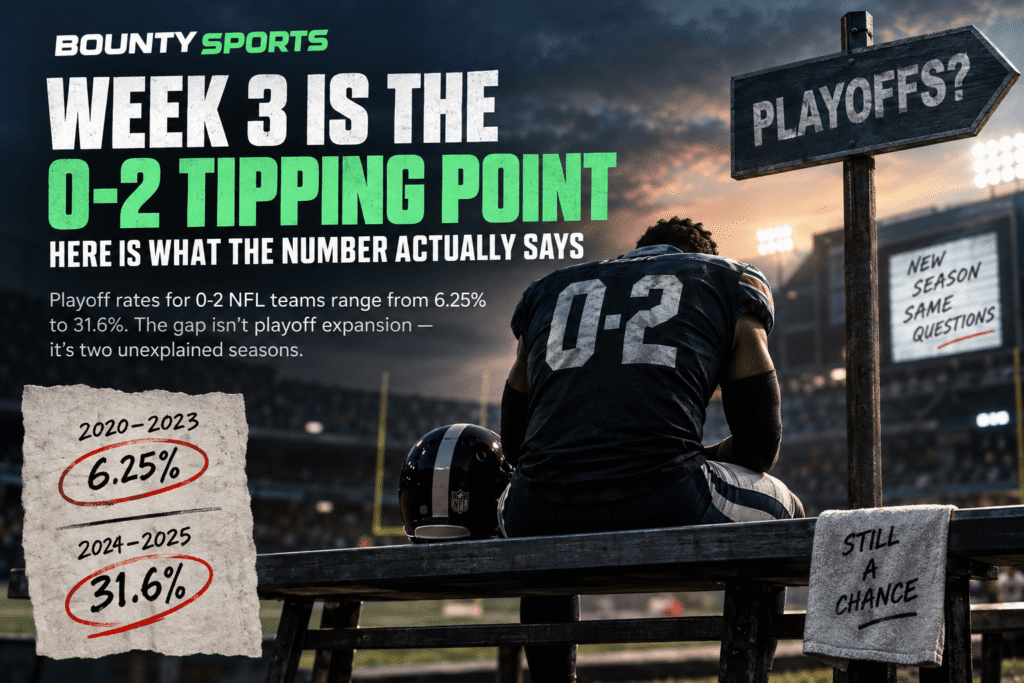
Week 3 is the 0-2 tipping point — here is what the number actually says
How often does an 0-2 NFL team make the playoffs? Depending on…

Bounty Sports
22 Sep 2026
NFL
The NFC North Will Be the NFL’s Best Division – and the Packers Will Be Left Out
Every team in the division can make a credible playoff case. That…
Bounty Sports
12 Aug 2026

NFL
The Seahawks Won the Super Bowl – Now Comes the Harder Part
Seattle has enough talent to remain near the top of the NFC.…
Bounty Sports
10 Aug 2026
Subscribe
By subscribing you agree to with our
Privacy Policy© 2026 Bounty Sports. All rights reserved.
NFL
The Next Great NFL Offense Will Be Built Around the Running Game
This is not a return to three-yards-and-a-cloud-of-dust football. The league's smartest offenses are using bigger personnel and a credible run threat to create easier, more explosive passes.
The NFL spent more than a decade teaching defenses to survive in space. Linebackers became lighter. Safeties became interchangeable. Nickel personnel stopped being a passing-down adjustment and became the default. Offenses spread the field, hunted matchups and turned every Sunday into a referendum on quarterback efficiency.
Then the league got smaller enough to be pushed around.
The most important offensive trend entering 2026 is not a new route concept or another variation of the quarterback run game. It is the return of size – multiple tight ends, extra linemen, condensed formations and backs who make a defense pay for staying light. The next great NFL offense will be built around the running game, but its real purpose will be to throw the ball more efficiently.
That distinction matters. This is not an argument for handing the ball off on second-and-10 to establish toughness. It is an argument for using the threat of the run to control which defenders are on the field, where they align and what coverages they can play.
The 2025 season was the warning
Next Gen Stats found that offenses used packages with fewer than three wide receivers on 41.7 percent of plays in 2025, the highest rate of the tracking era. From Week 10 onward, that figure rose to 44.5 percent. Defenses responded by playing base personnel on 29.7 percent of snaps, after failing to exceed 25 percent in any of the previous five seasons.
Those numbers describe a tactical shift, not nostalgia. Offenses discovered that a second tight end or extra lineman could force a defense to remove a defensive back. Once that happened, the offense did not have to run. It could isolate a linebacker in coverage, use play-action to move the second level or create a vertical route against a defense with fewer coverage specialists.
The Super Bowl participants offered the clearest evidence. Seattle used heavier packages on more than half its plays and averaged 7.5 yards per play from 12 personnel. Sam Darnold averaged 11.1 yards per pass attempt against base defenses. New England’s midseason turn toward jumbo packages helped its running backs jump from 3.8 yards per carry through nine weeks to a league-best 5.5 the rest of the way.
The point is not that both teams ran more. The point is that both teams made the defense wrong before the snap.
The run is valuable because of what it forces
For years, analytics debates reduced the run game to its average output compared with a pass. That was useful when teams treated every carry as an isolated decision. Modern offenses are treating the run as part of a personnel argument.
If a defense stays in nickel against two tight ends, the offense should be able to run at smaller bodies. If the defense substitutes into base, the offense can motion a tight end, empty the backfield or release the running back against a linebacker. The best play may still be a pass. It is simply a pass created by the credibility of the run.
This is why the next great offense will not necessarily lead the league in rushing attempts. It will lead the league in forcing defensive compromises. The running back’s value will be measured not only by yards but by whether the defense feels safe leaving a fifth defensive back on the field.
The league’s best rushing teams already show the ceiling
Buffalo led the NFL with 2,714 rushing yards and 30 rushing touchdowns last season. Baltimore averaged 5.2 yards per carry and finished just behind the Bills in total rushing output. Chicago also exceeded 2,400 yards. These teams arrived at those numbers differently, but all benefited from the stress created by quarterbacks, formations or backs who could punish one poor fit.
The lesson is not that every team needs a 1,600-yard running back. It is that an offense needs several credible answers from the same look. Buffalo can hand the ball to James Cook, use Josh Allen as the extra gap or throw behind a linebacker stepping toward the line. Baltimore can build around the threat of Lamar Jackson even when he never keeps the ball. The formation carries more possibilities than the defense can fully cover.
That is the future of the run game: not volume for its own sake, but multiplicity.
Roster construction will follow
Teams have spent years paying three wide receivers while treating the second tight end and interior offensive line as replaceable pieces. The heavy-personnel trend should alter that calculation. A tight end who can block well enough to stay on the field and run well enough to punish base defense is no longer a complementary player. He is a formation changer.
The same applies to running backs who can protect the quarterback and become legitimate receiving threats. If the back’s presence does not reveal whether the play is a run or pass, the offense maintains its conflict. If a specialist enters and announces the call, the entire advantage disappears.
Expect more teams to invest in pairs of tight ends, versatile fullbacks and linemen who can move in space. Expect the best coaches to carry a smaller number of personnel groups but build a larger number of outcomes from each one. Complexity will come from what the formation can become, not how many formations appear on the call sheet.
The counterargument
The strongest objection is simple: elite passing still wins. When a team falls behind, it cannot hide behind personnel conflict forever. Third-and-12 remains a quarterback problem. Postseason games are eventually decided by whether a passer can beat tight coverage after the defense understands exactly what is coming.
Correct. A great run structure does not replace quarterback talent. It protects it. It reduces the number of obvious passing situations, creates cleaner first reads and allows a quarterback to attack defenders who are on the field for the wrong reason. The strategy is not designed to make an average quarterback elite. It is designed to stop asking a good quarterback to play the hardest possible version of the position on every snap.
Where I land
The spread offense is not disappearing. Three-receiver personnel will remain the league’s most common grouping. But the teams that define 2026 will be the ones capable of becoming bigger without becoming predictable.
The next great offense will line up with two tight ends, invite the defense to choose its problem and punish the answer. It will run when the box is light, throw when the defense gets heavy and make both decisions look identical until the ball is snapped.
Football is not going backward. It is circling toward an old truth with better information: physical leverage still matters. The modern innovation is understanding that the best running game may reveal itself in the passing statistics.
What to watch
Watch 12-personnel usage, but also track what teams do from it. The important offenses will throw efficiently against base defense rather than merely increasing rushing volume. Watch tight ends who never leave the field, backs who can motion into the slot and quarterbacks whose play-action numbers rise. Those will be the clues that the league’s next offensive model has arrived.
Bounty Sports
10 Aug 2026
Related
NFL
The NFC North Will Be the NFL’s Best Division – and the Packers Will Be Left Out
Every team in the division can make a credible playoff case. That is exactly why one good team will spend January explaining how nine wins were not enough.
Bounty Sports
12 Aug 2026

NFL
The Chiefs’ Championship Window Is Closing Faster Than Anyone Wants to Admit
Patrick Mahomes gives Kansas City a chance in any season. He can no longer hide how much of the old championship machine has been replaced, weakened or asked to age one more year.
Bounty Sports
11 Aug 2026

NFL
NFL Week 3 opening lines: three numbers I think are wrong
Green Bay are better than Atlanta. Buffalo are better than the Chargers. San Francisco are better than Arizona. Fine. I’m not here to fight the entire Week 3 board. Most of it looks perfectly sensible, which is another way of saying most of it is boring. Three numbers aren’t. One moved five or six points ... NFL Week 3 opening lines: three numbers I think are wrong
Bounty Sports
21 Sep 2026
Subscribe
By subscribing you agree to with our
Privacy Policy© 2026 Bounty Sports. All rights reserved.