NFL
The Seahawks Won the Super Bowl – Now Comes the Harder Part
Seattle has enough talent to remain near the top of the NFC. Repeating, however, will require Sam Darnold and a changing roster to prove that last season was a foundation rather than a perfect storm.
The confetti is gone. The revenge story is complete. Seattle beat New England 29-13 in Super Bowl LX, Sam Darnold finished the most improbable rehabilitation project in modern quarterback history, and Mike Macdonald’s defense closed the season looking like the league’s next defining unit. That was the satisfying part. Now comes the revealing one.
Winning a championship answers every question for one night. Defending it asks new ones for eight months. The Seahawks will enter 2026 with the league’s most valuable label and its least forgiving schedule of expectations. They are no longer the clever team arriving early. They are the team everyone spent the offseason studying.
My forecast is straightforward: Seattle will win the NFC West again and return to the NFC Championship Game, but it will not repeat as Super Bowl champion. That is not a dismissal of the Seahawks. It is a judgment about how narrow the margin becomes when a champion changes coordinators, loses important depth and asks the same quarterback to recreate the best season of his career under brighter lights.
Darnold is no longer playing with house money
Last season, every good Darnold performance felt like found money. He was a former No. 3 pick on his fourth team, operating in a system that simplified his reads without shrinking the offense. By February, he was a champion. In 2026, the emotional math changes. Darnold is not trying to rescue his career anymore. He is trying to prove the rescue is permanent.
The supporting cast still gives him a fair chance. Jaxon Smith-Njigba has become the clear centrepiece of the passing game and was rewarded with a long extension. Cooper Kupp remains a valuable route runner and situational target. Rashid Shaheed brings the speed that forces a defense to defend every blade of grass, while AJ Barner looks ready to become more than the tight end who happened to score Seattle’s only offensive touchdown in the Super Bowl.
The more interesting change is on the sideline. Brian Fleury replaces Klint Kubiak as offensive coordinator. The system is expected to remain related, but related is not identical. The details that made Seattle difficult to prepare for – condensed formations, heavier personnel, play-action and a willingness to throw against base defense – were built through timing and sequencing. A new play caller can retain the vocabulary and still lose the rhythm.
Darnold does not need to be better than he was in 2025. He does need to remain decisive when defenses stop giving him the same answers. That is the champion’s tax: every tendency becomes a league-wide offseason project.
The running game is the first real warning
Kenneth Walker III is now in Kansas City. Zach Charbonnet is recovering from a torn ACL and may not be available at the start of the season. That places first-round rookie Jadarian Price in a role he was rarely asked to carry in college. Price has the burst and vision to contribute immediately, but Seattle cannot simply hand a rookie the old workload and call the problem solved.
The Seahawks did not win because they were a dominant rushing team in the traditional sense. They won because the threat of their run game shaped defensive personnel. When Seattle put multiple tight ends on the field, opponents had to decide whether to stay small and risk being moved off the ball or get bigger and expose linebackers in coverage. Without Walker and with Charbonnet’s availability uncertain, defenses may be less willing to respect the run before it proves it deserves that respect.
That sounds like a small distinction. It is not. Seattle’s passing efficiency was tied to the conflict its formations created. If the backfield loses credibility, the entire offense becomes a little easier to categorize.
The defense can keep Seattle near the top
The safest part of this prediction remains Macdonald’s defense. Seattle’s late-season shift toward split-safety coverage, enabled by Julian Love’s return, helped produce an eight-game winning streak to finish the season. The Seahawks could keep two safeties deep without becoming soft against the run because their defensive backs and front could survive without constant protection.
There has been turnover. Boye Mafe, Tariq Woolen and Coby Bryant are gone. Those are not ceremonial departures. They are players who handled real snaps in a defense built on disguise and interchangeable responsibilities. Seattle responded by extending Derick Hall, retaining Joshua Jobe and adding veterans such as Dante Fowler. The core remains good enough, but the second version of a championship defense is rarely as clean as the first.
Macdonald’s advantage is that the system is not dependent on one pass rusher winning immediately or one corner living on an island. Its strength is the picture it gives the quarterback before the snap and how quickly that picture changes afterward. That should travel. It should also be enough to keep Seattle from suffering the ordinary post-title collapse.
The case for a repeat
The obvious counterargument is that Seattle is unusually well positioned for a champion. Darnold is still only 29. Smith-Njigba is entering his prime. The offensive line has a legitimate anchor in Charles Cross. Macdonald is one of the league’s best young coaches, and the roster still ranks among the NFL’s deepest. Unlike some champions, the Seahawks are not trying to squeeze one more season from an aging quarterback and a decaying core.
All of that is true. It is also why I expect Seattle to remain in the final four of the NFC. But repeating requires more than having the best roster in July. It requires health, matchup luck and a second straight season in which the quarterback, coordinator and supporting cast remain in perfect alignment. Seattle already received that convergence once.
Where I land
The Seahawks are not disappearing. They are not a one-year novelty, and their title was not an accident. They will win the NFC West because their defense is the division’s most reliable unit and their offensive structure remains difficult to defend. They will reach January looking like a serious champion again.
They will also discover that the hardest part of winning the Super Bowl is not climbing the mountain. It is returning with every opponent carrying a map. Seattle will be excellent in 2026. This time, excellent will stop one game short of another trip to the Super Bowl.
What to watch
Watch the first six weeks of Seattle’s running game, especially Price’s workload and Charbonnet’s recovery. Watch how often Fleury keeps the heavy-personnel play-action package that defined the 2025 offense. Most of all, watch Darnold on third-and-long. If he continues winning when the formation no longer creates an easy answer, Seattle’s repeat bid will be more credible than I expect. If he starts holding the ball, the title defense will begin to look human.

""
10 Aug 2026
Related
NFL
The Next Great NFL Offense Will Be Built Around the Running Game
This is not a return to three-yards-and-a-cloud-of-dust football. The league's smartest offenses…

Bounty Sports
10 Aug 2026
NFL
The 2026 NFL Season Will Be Won in the Meeting Room, Not Free Agency
A record salary cap created another summer of expensive optimism. The teams…
Bounty Sports
7 Aug 2026
NFL
The Bills Have Run Out of Acceptable Excuses
Buffalo changed the coach, upgraded Josh Allen's receiving options and invested in…
Bounty Sports
11 Aug 2026
Subscribe
By subscribing you agree to with our
Privacy Policy© 2026 Bounty Sports. All rights reserved.
NFL
The Seahawks Won the Super Bowl – Now Comes the Harder Part
Seattle has enough talent to remain near the top of the NFC. Repeating, however, will require Sam Darnold and a changing roster to prove that last season was a foundation rather than a perfect storm.
The confetti is gone. The revenge story is complete. Seattle beat New England 29-13 in Super Bowl LX, Sam Darnold finished the most improbable rehabilitation project in modern quarterback history, and Mike Macdonald’s defense closed the season looking like the league’s next defining unit. That was the satisfying part. Now comes the revealing one.
Winning a championship answers every question for one night. Defending it asks new ones for eight months. The Seahawks will enter 2026 with the league’s most valuable label and its least forgiving schedule of expectations. They are no longer the clever team arriving early. They are the team everyone spent the offseason studying.
My forecast is straightforward: Seattle will win the NFC West again and return to the NFC Championship Game, but it will not repeat as Super Bowl champion. That is not a dismissal of the Seahawks. It is a judgment about how narrow the margin becomes when a champion changes coordinators, loses important depth and asks the same quarterback to recreate the best season of his career under brighter lights.
Darnold is no longer playing with house money
Last season, every good Darnold performance felt like found money. He was a former No. 3 pick on his fourth team, operating in a system that simplified his reads without shrinking the offense. By February, he was a champion. In 2026, the emotional math changes. Darnold is not trying to rescue his career anymore. He is trying to prove the rescue is permanent.
The supporting cast still gives him a fair chance. Jaxon Smith-Njigba has become the clear centrepiece of the passing game and was rewarded with a long extension. Cooper Kupp remains a valuable route runner and situational target. Rashid Shaheed brings the speed that forces a defense to defend every blade of grass, while AJ Barner looks ready to become more than the tight end who happened to score Seattle’s only offensive touchdown in the Super Bowl.
The more interesting change is on the sideline. Brian Fleury replaces Klint Kubiak as offensive coordinator. The system is expected to remain related, but related is not identical. The details that made Seattle difficult to prepare for – condensed formations, heavier personnel, play-action and a willingness to throw against base defense – were built through timing and sequencing. A new play caller can retain the vocabulary and still lose the rhythm.
Darnold does not need to be better than he was in 2025. He does need to remain decisive when defenses stop giving him the same answers. That is the champion’s tax: every tendency becomes a league-wide offseason project.
The running game is the first real warning
Kenneth Walker III is now in Kansas City. Zach Charbonnet is recovering from a torn ACL and may not be available at the start of the season. That places first-round rookie Jadarian Price in a role he was rarely asked to carry in college. Price has the burst and vision to contribute immediately, but Seattle cannot simply hand a rookie the old workload and call the problem solved.
The Seahawks did not win because they were a dominant rushing team in the traditional sense. They won because the threat of their run game shaped defensive personnel. When Seattle put multiple tight ends on the field, opponents had to decide whether to stay small and risk being moved off the ball or get bigger and expose linebackers in coverage. Without Walker and with Charbonnet’s availability uncertain, defenses may be less willing to respect the run before it proves it deserves that respect.
That sounds like a small distinction. It is not. Seattle’s passing efficiency was tied to the conflict its formations created. If the backfield loses credibility, the entire offense becomes a little easier to categorize.
The defense can keep Seattle near the top
The safest part of this prediction remains Macdonald’s defense. Seattle’s late-season shift toward split-safety coverage, enabled by Julian Love’s return, helped produce an eight-game winning streak to finish the season. The Seahawks could keep two safeties deep without becoming soft against the run because their defensive backs and front could survive without constant protection.
There has been turnover. Boye Mafe, Tariq Woolen and Coby Bryant are gone. Those are not ceremonial departures. They are players who handled real snaps in a defense built on disguise and interchangeable responsibilities. Seattle responded by extending Derick Hall, retaining Joshua Jobe and adding veterans such as Dante Fowler. The core remains good enough, but the second version of a championship defense is rarely as clean as the first.
Macdonald’s advantage is that the system is not dependent on one pass rusher winning immediately or one corner living on an island. Its strength is the picture it gives the quarterback before the snap and how quickly that picture changes afterward. That should travel. It should also be enough to keep Seattle from suffering the ordinary post-title collapse.
The case for a repeat
The obvious counterargument is that Seattle is unusually well positioned for a champion. Darnold is still only 29. Smith-Njigba is entering his prime. The offensive line has a legitimate anchor in Charles Cross. Macdonald is one of the league’s best young coaches, and the roster still ranks among the NFL’s deepest. Unlike some champions, the Seahawks are not trying to squeeze one more season from an aging quarterback and a decaying core.
All of that is true. It is also why I expect Seattle to remain in the final four of the NFC. But repeating requires more than having the best roster in July. It requires health, matchup luck and a second straight season in which the quarterback, coordinator and supporting cast remain in perfect alignment. Seattle already received that convergence once.
Where I land
The Seahawks are not disappearing. They are not a one-year novelty, and their title was not an accident. They will win the NFC West because their defense is the division’s most reliable unit and their offensive structure remains difficult to defend. They will reach January looking like a serious champion again.
They will also discover that the hardest part of winning the Super Bowl is not climbing the mountain. It is returning with every opponent carrying a map. Seattle will be excellent in 2026. This time, excellent will stop one game short of another trip to the Super Bowl.
What to watch
Watch the first six weeks of Seattle’s running game, especially Price’s workload and Charbonnet’s recovery. Watch how often Fleury keeps the heavy-personnel play-action package that defined the 2025 offense. Most of all, watch Darnold on third-and-long. If he continues winning when the formation no longer creates an easy answer, Seattle’s repeat bid will be more credible than I expect. If he starts holding the ball, the title defense will begin to look human.
Bounty Sports
10 Aug 2026
Related
NFL
The Chiefs’ Championship Window Is Closing Faster Than Anyone Wants to Admit
Patrick Mahomes gives Kansas City a chance in any season. He can no longer hide how much of the old championship machine has been replaced, weakened or asked to age one more year.
Bounty Sports
11 Aug 2026
NFL
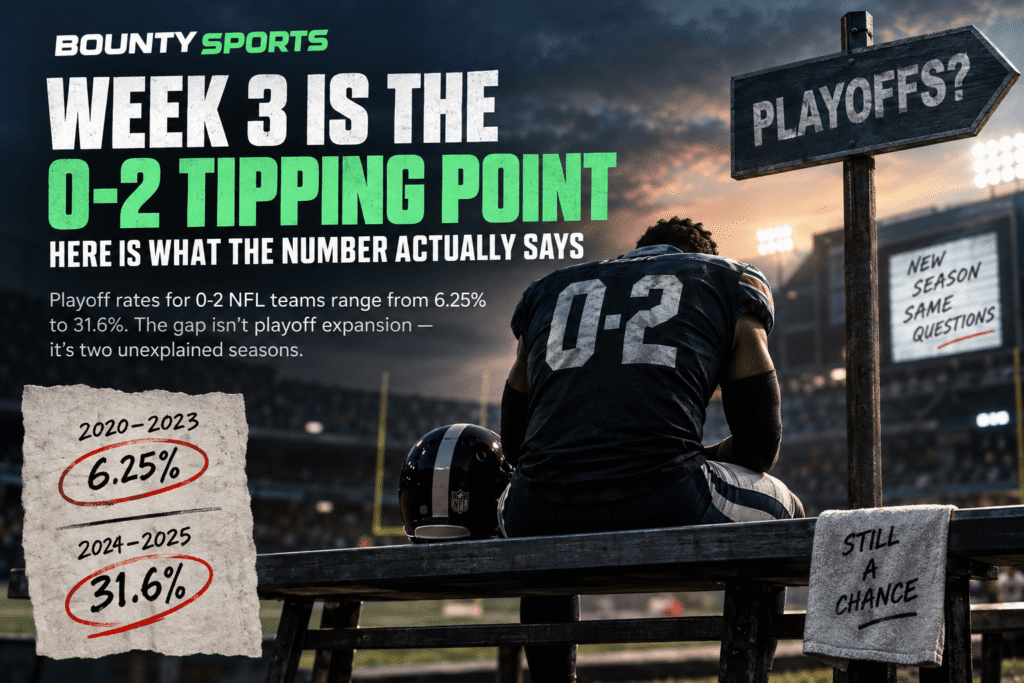
Week 3 is the 0-2 tipping point — here is what the number actually says
How often does an 0-2 NFL team make the playoffs? Depending on which number you find, somewhere between 6.25% and 31.6%. Useful. Both numbers come from real samples. Neither is necessarily wrong. They’re counting different seasons. Eight teams enter Week 3 at 0-2, so the usual statistic is doing the rounds again. The usual explanation ... Week 3 is the 0-2 tipping point — here is what the number actually says
Bounty Sports
22 Sep 2026
NFL
The Bills Have Run Out of Acceptable Excuses
Buffalo changed the coach, upgraded Josh Allen's receiving options and invested in the pass rush. The 2026 season can no longer be framed as another respectable step in a long process.
Bounty Sports
11 Aug 2026
Subscribe
By subscribing you agree to with our
Privacy Policy© 2026 Bounty Sports. All rights reserved.